
Top 5 Funds to Invest in India: A Practical Guide for Investors
Updated on 07-10-2026
Investing money in the right mutual fund can help individuals work towards long-term financial goals such as wealth creation, children's education, retirement and financial independence. However, with hundreds of mutual fund schemes available in India, choosing where to invest can sometimes become confusing.
People searching for the Top 5 Funds to Invest should understand that there is no single list that can be considered suitable for every investor. A fund that works well for a long-term investor may not be appropriate for someone who needs money in the short term.
Mutual fund investments are market-linked, and their value can rise or fall depending on market conditions. SEBI also states that past performance does not guarantee future performance.
Therefore, investors should select funds according to their financial goals, investment horizon and risk tolerance rather than choosing a scheme only because of its recent returns.
What Should You Look for in the Top 5 Funds to Invest?
Before selecting a mutual fund, investors should evaluate several factors. These include the fund's investment objective, portfolio, risk level, expense ratio, investment strategy, historical performance and suitability for the investor's goal.
The risk-o-meter is also an important factor because it provides an indication of the level of risk associated with a mutual fund scheme.
Instead of focusing only on returns, investors should ask:
-
What is the purpose of this investment?
-
How long can I stay invested?
-
How much market fluctuation can I handle?
-
Will I need the money in the short or long term?
-
Does the fund match my financial objective?
-
Is the portfolio sufficiently diversified?
Top 5 Fund Categories to Consider
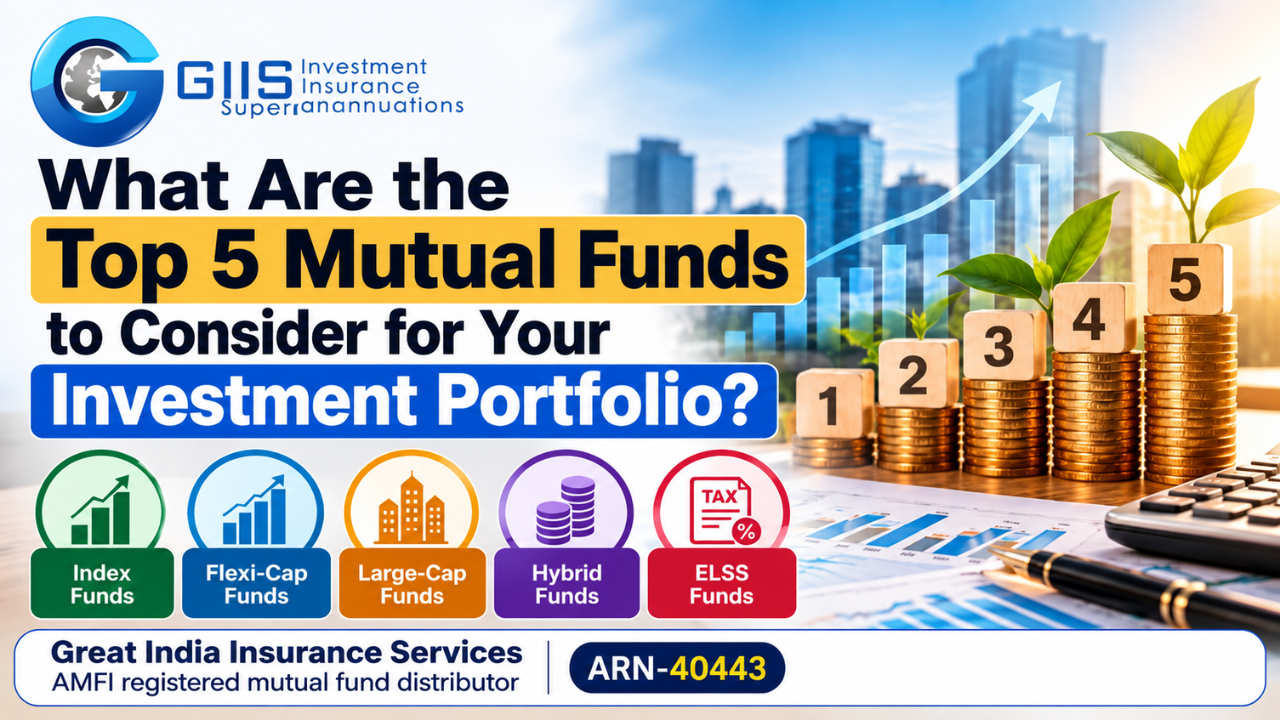
Rather than treating five individual schemes as universally best, investors can explore five major mutual fund categories based on their financial requirements.
1. Large-Cap Funds
Large-cap funds primarily invest in established companies with relatively large market capitalisation. These companies may have established business models and significant market presence.
Large-cap funds can be considered by investors looking for long-term equity exposure while preferring a portfolio focused on larger businesses.
However, these funds are still equity investments and can experience market fluctuations. They should therefore be selected according to the investor's risk tolerance and investment horizon.
2. Flexi-Cap Funds
Flexi-cap funds have the flexibility to invest across large-cap, mid-cap and small-cap companies.
This category can provide diversification across different segments of the equity market. It may be considered by investors who want a diversified equity portfolio without restricting the investment strategy to a particular market-cap segment.
For long-term investors, flexi-cap funds can form part of a broader wealth creation strategy.
3. Index Funds
Index funds follow a passive investment approach and generally aim to replicate a specific market index.
Because the strategy is based on tracking an index rather than frequently selecting individual securities, index funds can be relatively straightforward to understand.
Investors interested in a simple, diversified approach may consider index funds for long-term objectives. The performance of an index fund will depend largely on the underlying index, market movement and applicable costs.
4. Hybrid Funds
Hybrid funds combine different asset classes, commonly equity and debt.
This structure can provide diversification within a single mutual fund. Different hybrid fund categories have different equity and debt allocations, so investors should carefully understand the scheme's investment objective before investing.
Hybrid funds may be considered by investors who want exposure to multiple asset classes rather than investing exclusively in equity.
5. Mid-Cap Funds
Mid-cap funds invest primarily in companies that fall within the mid-cap segment. These companies can have significant growth potential, but they can also experience greater volatility than more established large-cap companies.
Investors considering mid-cap funds should generally have a longer investment horizon and the ability to tolerate market fluctuations.
They may be considered as part of a diversified portfolio rather than being used as the only investment category.
How to Choose the Best Fund for Your Goal?
The Top 5 Funds to Invest can differ depending on the purpose of the investment.
For long-term wealth creation, equity-oriented categories may be considered by investors who can handle market volatility.
For a retirement goal, the investment strategy should consider the number of years remaining until retirement, expected expenses and inflation.
For children's education, the investment horizon is particularly important. The Best Funds for Child Education should be selected according to the child's age, expected education expenses and family's risk tolerance.
Investors frequently ask, “Where to Invest for Child Education?” The answer depends on the time available before the financial goal. A longer horizon may allow greater exposure to growth-oriented investments, while a goal approaching within a few years may require greater focus on capital stability.
SIP and the Top 5 Fund Categories
A Systematic Investment Plan allows investors to invest a fixed amount at regular intervals.
SIP can be used with suitable mutual fund categories to create an organised investment habit. Instead of investing a large amount at one time, investors can contribute regularly according to their financial capacity.
For people looking for sip investment plans in Jamshedpu, the appropriate monthly amount should be based on income, expenses, existing savings and financial goals.
Increasing the SIP amount periodically as income grows can also help investors work towards larger long-term financial objectives.
Mutual Funds in Jamshedpur
Investors searching for mutual funds in Jamshedpur can explore different categories according to their personal financial requirements.
Someone in the early stages of their career may have a longer investment horizon and therefore greater flexibility to consider equity-oriented funds. An individual approaching retirement may have different requirements and may need a more balanced approach.
The same mutual fund cannot automatically be considered suitable for every investor.
Retirement Planning Services in Jamshedpur
Retirement planning requires a long-term approach because expenses may continue for many years after retirement.
Retirement planning services in Jamshedpur can help individuals understand their expected retirement corpus, inflation-adjusted expenses, existing investments and required monthly contributions.
SIPs, mutual funds and other suitable financial products can be considered as components of a retirement strategy depending on individual requirements.
Tax Planning Services in Jamshedpur
Taxation can influence the overall outcome of an investment. Tax planning services in Jamshedpur can help individuals understand applicable tax considerations and evaluate tax-efficient investment choices.
However, investors should not select a mutual fund simply because of a potential tax benefit. Risk, liquidity, investment period and financial objectives should also be considered.
Corporate Treasury Investment Solutions Jamshedpur
Businesses may also need investment solutions for managing surplus cash.
Corporate treasury investment solutions Jamshedpur can help businesses evaluate suitable ways to manage excess funds while considering liquidity requirements, operational cash flow, risk and investment duration.
Corporate investments require a different approach because companies may need funds for working capital, expansion, salaries and other business requirements.
Why Choose GIIS Financial?
Selecting a mutual fund should be part of a broader financial strategy rather than a decision based only on recent returns. GIIS Financial provides financial planning and investment-related solutions designed around different financial goals.
Whether you are exploring the Top 5 Funds to Invest, starting an SIP, planning for your child's education or building a retirement corpus, understanding the relationship between risk, return and investment duration is essential.
Frequently Asked Questions
Which are the Top 5 Funds to Invest in India?
There is no universally applicable list of five best mutual funds. Investors can explore categories such as large-cap, flexi-cap, index, hybrid and mid-cap funds according to their goals and risk tolerance.
Which mutual fund is best for beginners?
Beginners should consider their investment objective, time horizon and risk tolerance before selecting a mutual fund category. A simple and diversified approach may be easier to understand than selecting funds solely on recent returns.
Are mutual funds safe for long-term investment?
Mutual funds are market-linked investments and are not risk-free. Long-term investing can help investors manage short-term market fluctuations, but returns are not guaranteed.
Is SIP suitable for long-term investment?
SIP can be a useful method for making regular investments over a long period. The actual outcome depends on the selected mutual fund, market performance, investment amount and investment duration.
What should I check before investing in a mutual fund?
Check the scheme's objective, risk-o-meter, portfolio, costs, historical performance and suitability for your financial goal. Investors should also read the relevant scheme documents before investing.
Share On

















0
Comment