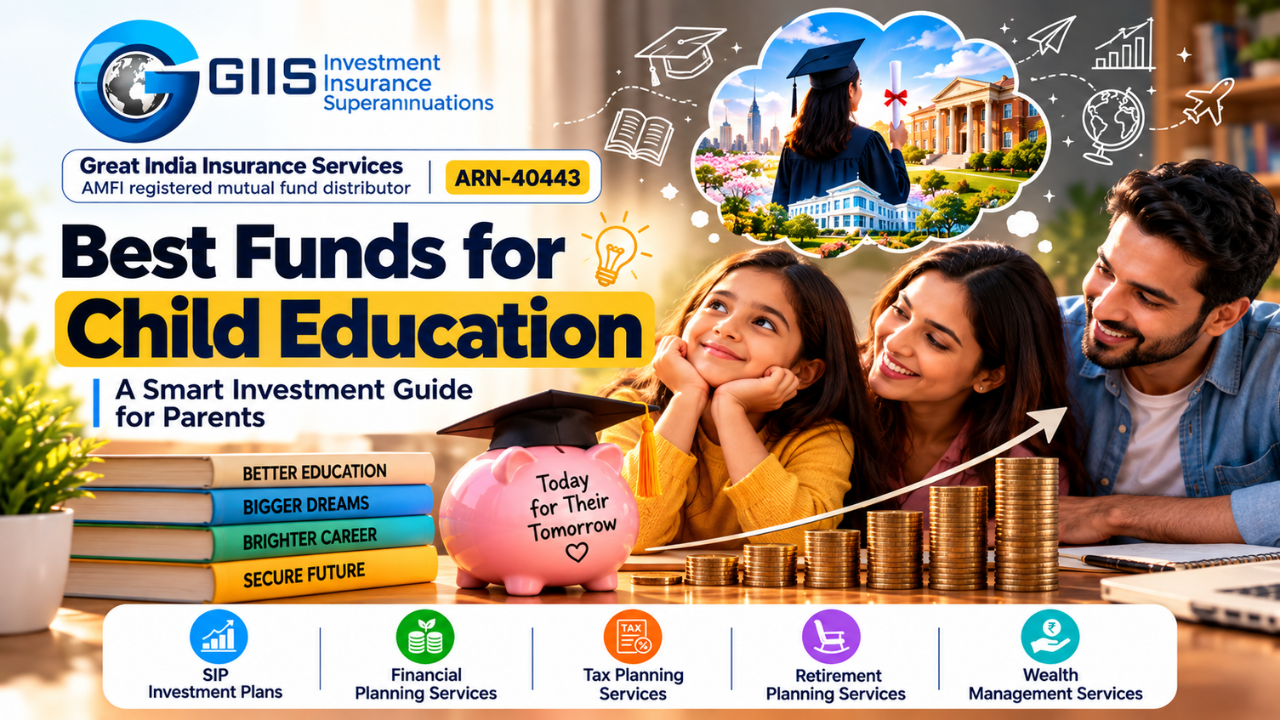
Best Funds for Child Education: A Smart Investment Guide for Parents
Updated on 05-10-2026
Every parent wants to provide their child with quality education and better career opportunities. However, with rising education costs in India and abroad, planning for a child's future requires careful financial preparation. Choosing the best funds for child education can help parents build a dedicated education fund over time while keeping their long-term financial goals in mind.
Whether you are planning for school education, higher studies, or an international university, starting early can make a meaningful difference. GIIS Financial offers financial planning and investment-related services to help families understand their options and prepare for their children's educational expenses.
In this blog, we will explore suitable investment options, the role of mutual funds, and how parents can plan for their child's education.
Why Is Financial Planning Important for Child Education?
Education expenses can increase significantly over the years. Tuition fees, accommodation, books, transportation, and other academic costs can create a considerable financial burden if parents do not plan in advance.
A structured investment strategy can help parents:
- Build a dedicated education fund for future expenses.
- Manage rising education costs through long-term investing.
- Develop disciplined savings habits with regular investments.
- Reduce the need to depend entirely on loans for higher education.
- Balance education goals with other financial priorities.
Parents looking for financial planning services in Jamshedpur can explore different investment strategies based on their child's age, education goals, investment horizon, and financial situation.
What Are the Best Funds for Child Education?
There is no single mutual fund that is suitable for every child's education goal. The right choice depends on how much money you need, how many years you have to invest, and how much market risk you can accept.
Here are some investment categories parents can consider.
1. Equity Mutual Funds for Long-Term Education Goals
Investment horizon: Generally 7–10 years or longer, depending on risk tolerance.
Equity mutual funds invest primarily in stocks and can offer long-term growth potential. They may be considered by parents who have several years before their child's higher education expenses begin.
Some categories include:
- Flexi-cap mutual funds
- Large-cap mutual funds
- Index mutual funds
- Large and mid-cap mutual funds
Equity investments are subject to market fluctuations and can experience losses, particularly over shorter periods. Parents should gradually reduce exposure to market volatility as the education goal approaches.
2. Hybrid Mutual Funds for Balanced Investing
Hybrid mutual funds invest in a combination of equity and debt instruments. They may suit investors seeking a balance between growth potential and relatively lower volatility than an equity-heavy portfolio.
The level of risk depends on the fund's asset allocation. Hybrid funds are not risk-free, and their returns are not guaranteed.
3. Debt Mutual Funds for Relatively Shorter Goals
Debt mutual funds invest primarily in fixed-income securities such as government and corporate bonds.
They may be considered for education expenses that are approaching, depending on the fund's credit quality, interest-rate risk, and investment horizon.
Debt mutual funds are not guaranteed-return products and can also experience losses.
How Can SIP Investment Plans in Jamshedpur Help Parents?
A Systematic Investment Plan (SIP) allows investors to invest a fixed amount in a mutual fund at regular intervals, usually monthly.
For parents planning their child's future, SIP investment plans in Jamshedpur can make it easier to invest consistently without needing a large amount of money at the beginning.
For example, investing ?5,000 per month for 15 years means contributing a total of ?9 lakh before any investment gains or losses.
The final value will depend on the actual performance of the selected fund, expenses, and market conditions. SIPs do not guarantee profits or protect against losses.
Families exploring the best SIP investment plans in India for beginners should consider their financial goals, risk tolerance, and investment period before selecting a fund.
How to Choose the Right Investment for Your Child's Education
Before investing, parents should evaluate a few important factors.
1. Identify Your Education Goal
Decide whether the money is required for school fees, undergraduate studies, postgraduate education, or overseas education.
2. Estimate Future Education Costs
Consider the current cost of education and the potential impact of inflation. International education may require additional planning for currency fluctuations and living expenses.
3. Select an Investment Horizon
A goal that is 12 years away may allow a different investment approach from one that is only 3 years away.
4. Understand Investment Risk
Avoid selecting funds based only on recent returns. Review the fund's investment strategy, risk profile, costs, and consistency across market conditions.
5. Review and Adjust Your Portfolio
As the education date approaches, consider moving some of the accumulated money into relatively lower-risk options to reduce the impact of market fluctuations.
How GIIS Financial Supports Education and Financial Planning
GIIS Financial helps individuals and families explore investment and financial planning options according to their financial goals.
Parents looking for financial planning services in Jamshedpur can consider a broader financial strategy that includes education savings, retirement preparation, tax planning, and wealth management.
The company's financial services may be relevant to families exploring:
- Tax planning services in Jamshedpur to understand tax-efficient financial decisions.
- Retirement planning services in Jamshedpur to prepare for long-term retirement needs.
- Financial planning services for salaried employees in India to organize income, savings, and financial goals.
- Wealth management services in India for high returns with a focus on investment planning, risk assessment, and long-term financial objectives.
Investment returns are not guaranteed, and higher return expectations generally involve higher investment risk.
What Are the Best Investment Options in India for High Returns?
Investors searching for the best investment options in India for high returns can explore several categories, including equity mutual funds, hybrid mutual funds, stocks, fixed-income products, and other regulated investment options.
However, no investment can guarantee high returns without risk.
Parents should be cautious when searching for a low risk high return mutual funds agent, because low risk and high returns do not necessarily go together. Mutual fund investments are subject to market risks, and the level of risk varies by category and portfolio.
Families looking for mutual funds in Jamshedpur should compare investment objectives, costs, risk levels, and suitability rather than choosing funds only by their past performance.
Frequently Asked Questions (FAQs)
Which mutual funds are suitable for child education?
Equity, hybrid, and debt mutual funds may be considered depending on the child's age, investment horizon, financial goals, and risk tolerance.
When should parents start investing for their child's education?
Starting early can provide more time to build savings through regular investments. The suitable starting point depends on the child's age and the expected education expenses.
Are SIPs suitable for child education planning?
SIPs can help parents invest regularly toward long-term education goals. However, mutual fund returns are market-linked and are not guaranteed.
Can parents use mutual funds for overseas education?
Yes. Mutual funds can form part of an overseas education plan, but parents should also consider currency movements, tuition inflation, and the timing of withdrawals.
How can GIIS Financial help with education planning?
GIIS Financial provides financial planning and investment-related services that can help families explore options for organizing their finances around long-term goals, including education.
Conclusion
Planning for your child's education requires a clear financial goal, disciplined investing, and an understanding of market risks. The best funds for child education depend on your family's financial situation, the time available, and the amount you need to accumulate.
By exploring mutual funds, SIPs, and other investment options, parents can create a structured approach to future education expenses.
GIIS Financial can help families explore financial planning and investment options while considering education goals alongside retirement, tax planning, and long-term wealth management.
Share On


















0
Comment